MN should join the growing list of states ending Line Extension Allowances

On June 4, the Minnesota Public Utilities Commission (PUC) is scheduled to hold a hearing on the matter of gas utility Line Extension Allowances as part of the Future of Gas proceeding. Line extension allowances are gas utility policies that force existing customers to pay part of the cost of expanding the gas system to new customers. Rather than each new gas customer paying the entire upfront cost of the connection themselves, part of the costs (plus the utility’s return on investment) is built into the rates that all gas customers pay each month.
Read more about why we should end line extension allowances here.
CUB—along with more than 30 other organizations and state agencies—has asked the PUC to stop allowing this subsidy. Ending Line Extension Allowances is one piece of the puzzle to start addressing the future affordability of gas rates for Minnesotans.
Like many states, Minnesota gas utilities are overspending on infrastructure costs
Forty years ago, the majority of customers’ gas bills went towards the cost of paying for gas itself. But according to a new analysis from the Future of Heat Initiative (FOHI), although the average residential customer is progressively using less gas, their bills are still increasing. FOHI’s analysis also explains a major reason why Minnesotans are paying more money for less gas: utilities’ spending on pipes and infrastructure is driving the increase.
Every year, Minnesota gas utilities spend billions of dollars replacing, repairing, and expanding the gas system—and they have plenty of incentive to do so. Although utilities don’t make a profit from the gas they sell, they do earn a return on their investments in infrastructure, including the physical gas pipelines they install.
FOHI’s recent findings echo concerns raised in CUB’s 2023 report, showing that annual infrastructure investments made by Minnesota’s three largest gas companies more than tripled from $218 million in 2013 to $700 million in 2022.
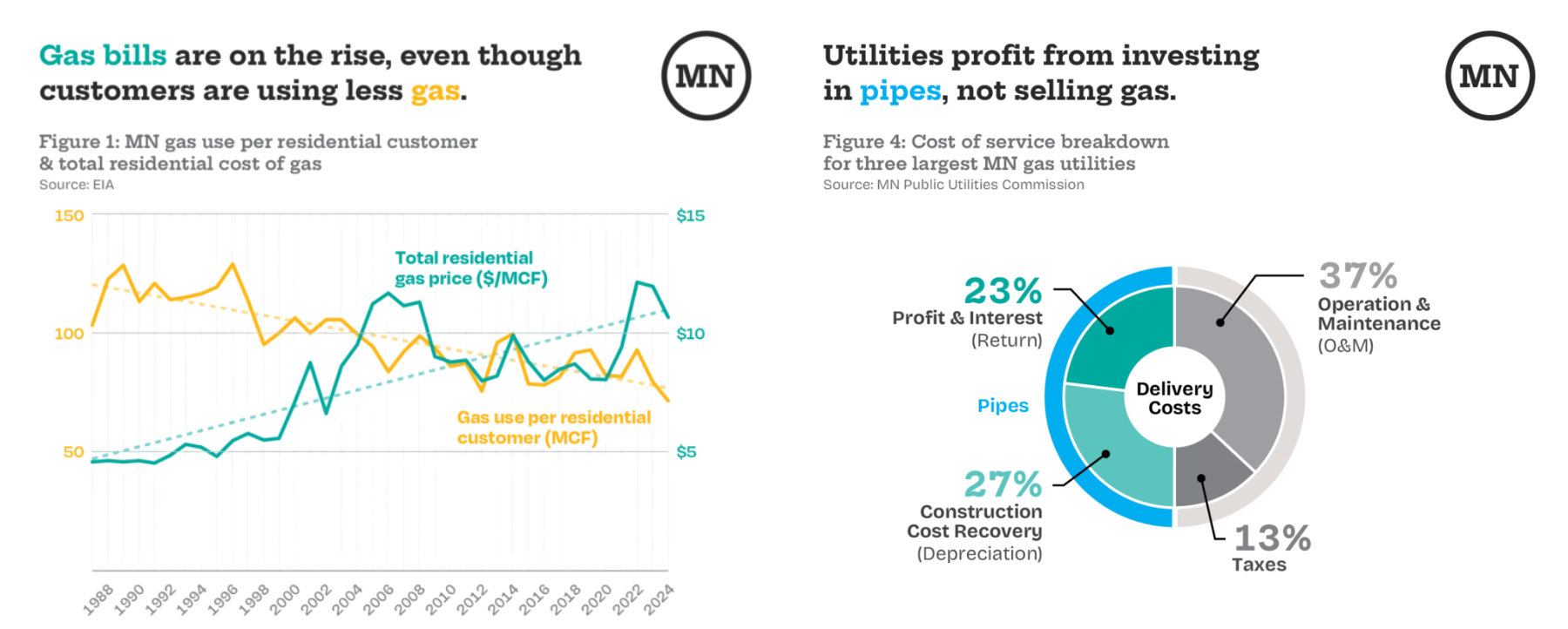
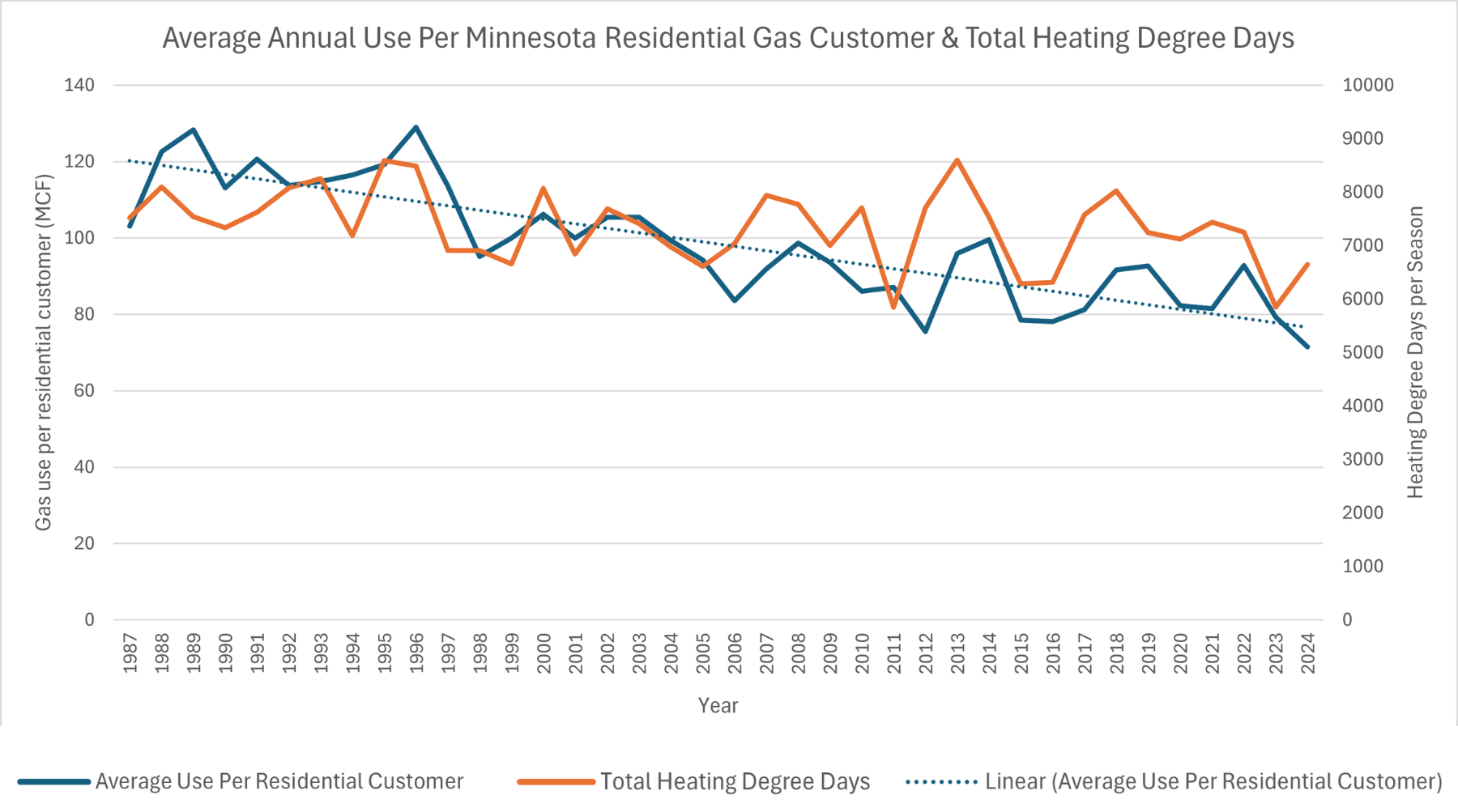
Meanwhile, average household gas use is declining.
Today, the average household’s use of natural gas is declining as home weatherization improves, appliances get more efficient, electric technologies like heat pumps take on an increasing amount of the tasks previously done by gas, and average winter temperatures rise.
CenterPoint, Minnesota’s largest gas utility, also confirmed that individual customer gas usage has declined due to energy efficiency measures. This follows trends across Minnesota seen in data from the U.S. Energy Information Administration (EIA) that shows average annual use per residential gas customer in Minnesota is trending down.
While a level of investment is necessary to ensure safe and reliable transportation of gas, the speed of investment over the last several decades has driven up the cost of gas service. Continuing at this pace is not sustainable for Minnesotans. The cost of these investments—plus a return for utility companies—is recovered from customers over many decades, meaning that investments made today are locking Minnesotans into higher bills for years to come.
If infrastructure investments continue to outpace sales, it will drive rates up even more quickly. Even if customer gas demand remains high on the coldest days, rates will have to increase as weatherization, air source heat pumps, and other advancements mean that customers purchase less gas at most other times of the year.
While a level of investment is necessary to ensure safe and reliable transportation of gas, the speed of investment over the last several decades has driven up the cost of gas service. Continuing at this pace is not sustainable for Minnesotans. The cost of these investments—plus a return for utility companies—is recovered from customers over many decades, meaning that investments made today are locking Minnesotans into higher bills for years to come.
If infrastructure investments continue to outpace sales, it will drive rates up even more quickly. Even if customer gas demand remains high on the coldest days, rates will have to increase as weatherization, air source heat pumps, and other advancements mean that customers purchase less gas at most other times of the year.
Eliminating Line Extension Allowances can help
When Line Extension Allowances were initially approved in the 1990s, natural gas was rapidly expanding in Minnesota, and adding new customers to the system helped spread the cost of gas infrastructure across more people, which kept rates low for all customers. But today, these investments serve as a risk to existing gas customers who may be on the hook to pay for pipelines that deliver much less gas (and therefore result in much lower revenues) than currently forecasted.
Fortunately, Line Extension Allowances are no longer necessary. Even without an allowance, building owners are free to join the gas system; they would simply cover the cost of the new pipe to serve them. And as electric alternatives become increasingly cost-competitive, fewer Minnesotans are interested in adding gas service. Xcel recently reported slowed growth rates for several projects in central and western Minnesota, explaining:
“Interest in converting to natural gas has slowed as the market shifts toward electrification. In addition, the cost advantage of natural gas over other energy options has narrowed, while [gas] conversion expenses have increased. As a result, we are seeing reduced interest from both potential conversion customers and new residential construction projects.”
RMI has calculated that eliminating Line Extension Allowances would save Minnesota ratepayers $34 million per year. This is one modest, common-sense opportunity to reduce the infrastructure cost pressures that continue to drive up gas rates.
Other states are already taking action on Line Extension Allowances
Driven by similar affordability concerns, decision-makers in other states have begun to take action on Line Extension Allowances. Last year, New York Governor Hochul signed into legislation a law that would eliminate these subsidies, observing:
“It’s simply unfair, especially when so many people are struggling right now, to expect existing utility ratepayers to foot the bill for a gas hookup at a brand new house that is not their own.”
California, Colorado, Oregon, and Washington have also begun to eliminate or fully phase out Line Extension Allowances, and other states are reviewing similar proposals.
Next Steps
The PUC will hold a hearing on June 4 to ask parties who submitted comments in the docket questions and ultimately make a final decision. Anyone interested in watching the proceeding can view a live webcast that will be available starting at 10am on the Commission’s website. Check CUB’s website for an update following the hearing.