A look into Minnesotans’ rising gas bills

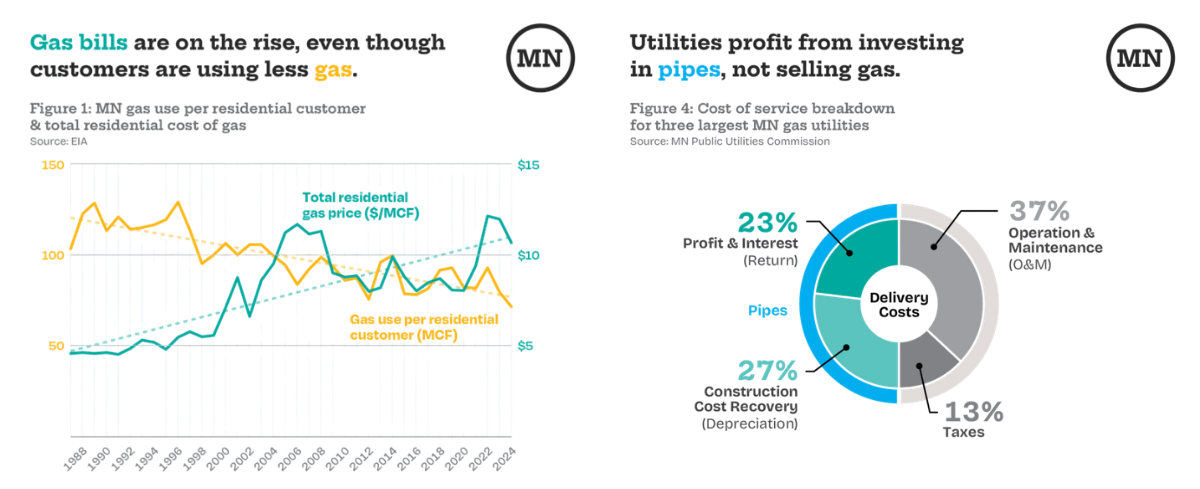
In 2024, the typical Minnesota residential gas customer used 23% less gas than five years earlier, yet total bills went up 32% over the same period. That’s the conclusion of a new analysis from the Future of Heat Initiative (FOHI). The analysis also explains a major reason why: utilities’ spending on pipes and the distribution system is driving the increase.
Minnesotans are paying more money for less gas
Forty years ago, the majority of your gas bill went towards the cost of paying for gas itself. According to FOHI’s report, now over half of customer charges go toward pipes and other costs to distribute the gas, rather than the gas itself.
Every year, Minnesota gas utilities spend billions of dollars replacing, repairing, and expanding the gas system—and they have plenty of incentive to do so. Although utilities generally don’t make a profit from the gas they sell, they do earn a return on their investments in infrastructure, including the physical gas pipelines they install.
FOHI’s recent findings echo concerns raised by CUB in a 2023 report, showing that annual infrastructure investments made by Minnesota’s three largest gas companies more than tripled from $218 million in 2013 to $700 million in 2022.
A growing problem
For nearly two decades, Minnesota’s gas utilities have both expanded their systems and rapidly replaced existing pipes. A level of investment is necessary to ensure safe and reliable transportation of gas, particularly with pipes made of old, more leak-prone materials. However, the speed of investments has driven up the cost of gas service, and continuing at this pace is not sustainable for Minnesotans.
The cost of these investments—plus a return for utility companies—is recovered from customers over many decades, meaning that investments made today are locking Minnesotans into higher bills for years to come.
At the same time, the average household’s use of natural gas is flat, or even declining, as home weatherization improves, appliances get more efficient, and electric technologies like heat pumps take on an increasing amount of the tasks previously done by gas. Xcel recently reported, too, that fewer Minnesota households are converting to natural gas, as electric alternatives are increasingly cost-competitive. Demand for new gas service is lower than what the company had projected across several expansion projects here in Minnesota, reflective of new market shifts toward electrification. If infrastructure investments continue to outpace sales, as expected, it will drive rates up even more quickly.
What can we do?
Driven by affordability concerns, decision-makers in other states have begun to take a more critical look at proposed gas investments. Following their lead, Minnesota should take two immediate steps to reduce these costs for ratepayers:
Eliminate overspending on early and unnecessary pipeline replacements
- Stop subsidizing expansion of the gas system
- Reduce utility companies’ authorized “returns on equity,” key determinants of the companies’ profits. CUB regularly advocates for more reasonable returns. Read more here.
The state agency that reviews and approves these costs, the Minnesota Public Utilities Commission (PUC), currently has two ongoing proceedings that could make a difference. The first proceeding relates to “line extension allowances:” gas utility policies that force existing customers to pay part of the cost of expanding the gas system to new customers. These costs are built into the rates that utilities charge for gas service. Between 2023 to 2024, Xcel alone charged customers over $19 million to pay for extending pipes to connect new customers. CUB—along with more than 30 other organizations and state agencies—has asked the PUC to stop allowing this subsidy. Comments have been submitted (in PUC Docket No. 21-565), and we are awaiting a hearing for the Commission’s decision. You can learn more about these policies and why CUB thinks they should be eliminated here.
Another ongoing proceeding is Xcel’s latest request to increase rates for its natural gas customers. Less than eight months after the PUC approved Xcel’s last rate increase, the utility asked for another 8.2% increase to rates. If approved, that would raise the average residential customer’s bill by $7 a month, or $85 a year.
A key driver of Xcel’s request is tens of millions of dollars in investments to reinforce or grow the gas system. For example, Xcel aims to spend almost $19 million to more than double the size of an existing pipeline. They argue this change is needed to make the pipe large enough to serve speculative future customers should they materialize at some point down the road. But the company provided insufficient data to support the proposed project size and scope, and gave little consideration to alternatives that might be less costly to their customers. Again, although some investments may be reasonable to maintain safe and reliable service to the Company’s customers, unsupported expansion and replacement of the system is unreasonable for ratepayers.
The Commission should ensure any such investments are sufficiently scrutinized and only those investments that are needed to furnish reasonable service should be approved for recovery. Anyone interested in filing comments can do so by emailing consumer.puc@state.mn.us and citing Docket No. 25-356, or using this online form. Anything submitted in the comment—including your name, email address, and any other information you share—will become a part of the public record.